
Remove the background. Keep the indication.
Watch selective removal, read the lesson excerpt, and explore what too little or too much washing does to the result.
No account or card needed. Samples do not record training hours or issue certificates.
Wash to Background, Never Past It
An explainer from Removal of Surface Penetrant. Read the selected lesson text below, or continue to the interactive practice.
From the course lesson
Selective Removal: The Razor's Edge
Removal has one purpose: take the penetrant off the surface while leaving it in the flaws. Missing in either direction ruins the test.
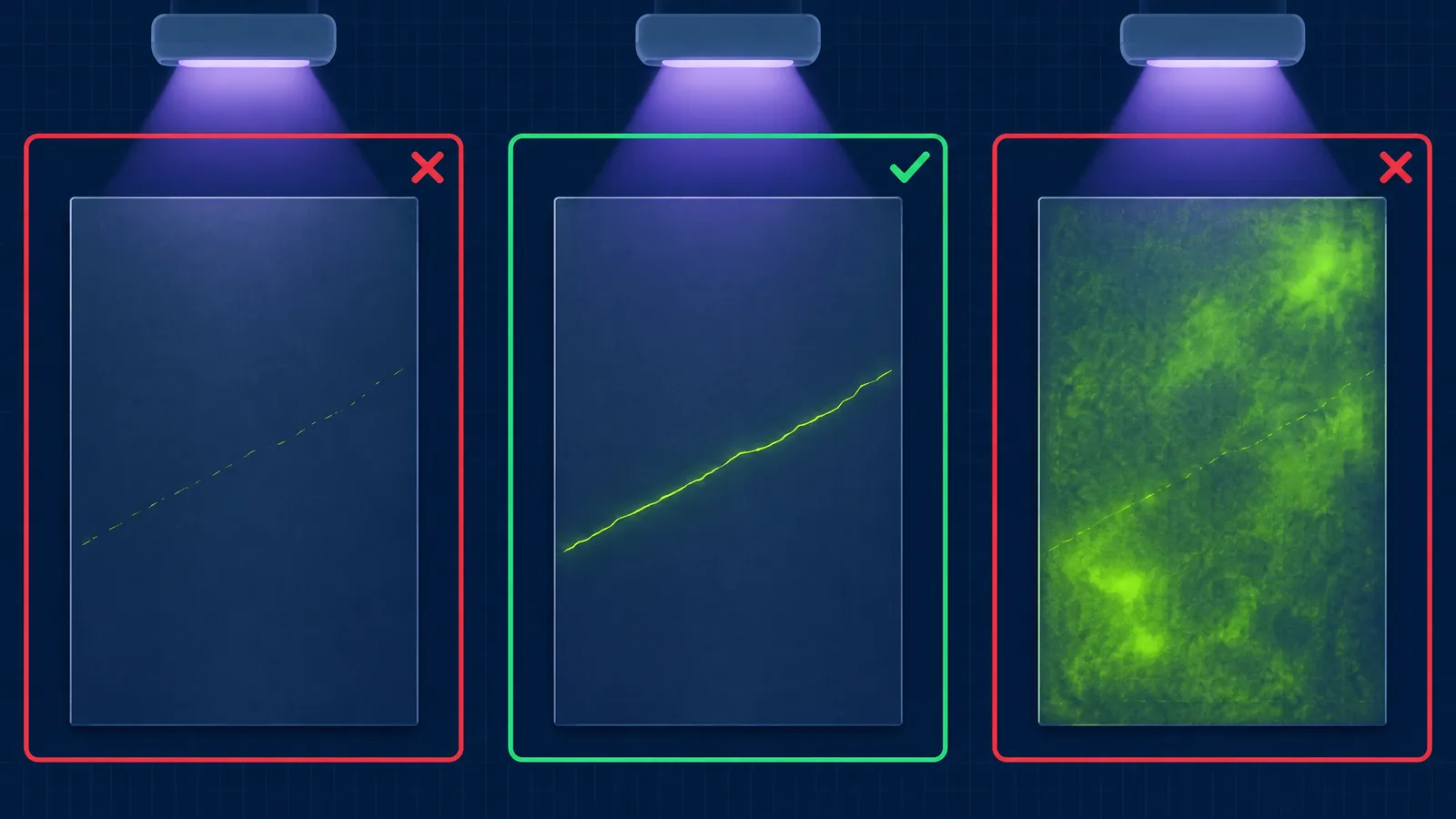
- Underwashing leaves surface penetrant behind. Under UV-A it shows as background glow; with visible dye, as a red haze or smear. Indications have to compete with that noise, and the fine ones lose. - Overwashing keeps removing after the surface is clean. Water, solvent, or emulsifier reaches into the flaws and strips the penetrant that capillary action spent the whole dwell placing there. The part then looks perfect and inspects clean, which is exactly why overwashing is the classic PT sin.
The removal technique follows the penetrant Method: A (water-washable), B (post-emulsifiable, lipophilic), C (solvent-removable), and D (post-emulsifiable, hydrophilic). Each has its own controls and its own way of going wrong, and ASME Section V, Article 6 together with your written procedure sets the parameters for all of them.
Overwash, Underwash, and Recovery
Learn to read the wash result the way an inspector will:
- Overwashed: the surface looks flawless, dark and clean under UV-A or spotless with visible dye. Indications are faint, broken, or missing, and a stripped flaw looks exactly like a sound part. Causes: washing past background, excessive water pressure or temperature, a needle-jet spray, flooded solvent, or emulsifier contact left too long. With visible dye, ASME Section V, Article 6 notes that a light pink indication may point to excessive cleaning. Recovery is total: clean the part, dry it, and reprocess from penetrant application; a brief re-application of penetrant over a stripped surface is not a qualified shortcut. - Underwashed: background glow or dye haze remains, speckled, smeared, or pooled in surface roughness. Real indications can hide inside it, and developer over heavy residue gives a noisy, unreadable result. ASME treats broad areas of fluorescence or pigmentation that could mask indications as unacceptable: they are cleaned and reexamined. Your procedure may allow a brief, controlled additional wash; beyond that, reprocess.
Because an overwashed part looks *good*, process discipline at the wash station is the only real defense: pressure, temperature, time, technique, and lighting. The daily system performance check on a known-defect panel is what catches a wash that has quietly drifted into destroying indications.
Try it yourself
Use the wash controls to remove the surface background while preserving penetrant in the discontinuity. Inspect the result, then reset and compare.
This teaching model illustrates the principle. It does not replace practical training on your employer's equipment or an approved examination procedure.
Choose the training your work requires.
The full course includes the published syllabus, assessments and formal training records. Employer qualification and certification remain governed by the written practice.