
Move the probe. Read the returning echo.
Watch contact testing, read about the sound path, then move a probe and observe the A-scan response.
No account or card needed. Samples do not record training hours or issue certificates.
Hands On the Part: Contact Testing
An explainer from Contact Testing Overview. Read the selected lesson text below, or continue to the interactive practice.
From the course lesson
What Contact Testing Is
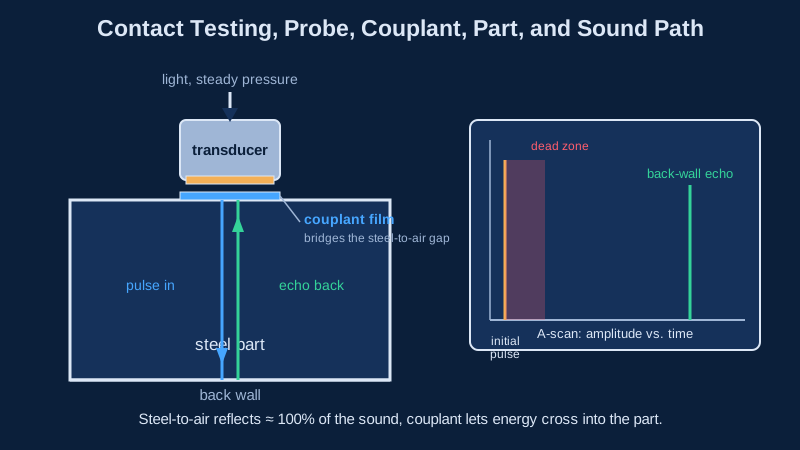
In contact testing the transducer is placed directly on the test surface, separated only by a thin film of couplant, and the inspector moves it by hand. There is no water tank, no standoff column, and no mechanized carriage in the basic method, just the probe, a layer of couplant, and the part. That simplicity is the whole reason contact testing is the workhorse of field UT. The equipment fits in a single case, setup takes minutes, and the technique reaches places no tank ever could: a weld on an elevated pipe rack, the shell of an in-service vessel, a structural connection in a building frame. The basic contact families you will use are:
- Straight (normal) beam, longitudinal waves straight into the part for thickness gauging and lamination detection. - Angle beam on a wedge, shear waves injected at 45°, 60°, or 70° for weld examination. - Dual element, separate transmit and receive crystals in one housing, excellent on thin and corroded material and near-surface work. - Delay line, a short plastic standoff that moves the dead zone out of the part for thin-section precision thickness.
Why Couplant Is Part of the Sound Path
Ultrasound is mechanical vibration, so the energy must physically cross from the probe face into the metal. The problem is the interface. Even a probe pressed firmly on clean steel traps a microscopically thin layer of air, and the steel-to-air boundary reflects nearly 100% of the sound straight back, almost nothing crosses. That trapped air is an acoustic wall. Couplant removes the air. A liquid or gel whose acoustic impedance sits between air and the steel lets the energy bridge the gap instead of bouncing off it. This is the same impedance-mismatch physics that makes a flaw visible, we exploit it at the flaw and defeat it at the front surface. Common couplants include water, glycerin, cellulose-based gels, oils, and proprietary pastes; high-temperature couplants are formulated for hot surfaces where ordinary gels boil or burn off. The couplant is not a lubricant and not optional, it is part of the acoustic path. A dry spot means no signal reaches the part, so the entire scan zone must stay wetted.
Try it yourself
Drag the probe, or use the Probe position slider, until the flaw echo peaks. Compare its depth with the back-wall echo.
This teaching model illustrates the principle. It does not replace practical training on your employer's equipment or an approved examination procedure.
Choose the training your work requires.
The full course includes the published syllabus, assessments and formal training records. Employer qualification and certification remain governed by the written practice.