
Magnetic particle vs liquid penetrant testing
The main difference is material suitability and what produces the indication. Magnetic particle testing (MT) uses magnetization and particles to reveal surface and near-surface discontinuities in ferromagnetic materials. Liquid penetrant testing (PT) uses a liquid to reveal discontinuities open to the surface of suitable nonporous materials. Choosing between them starts with the part and inspection requirement, rather than which kit is available.
Sources: ASNT magnetic particle testing overview; ASNT liquid penetrant testing overview.
Compare the method with the inspection problem
For learners, the comparison also explains why the methods need separate training. Both produce indications that an inspector observes, but the process controls behind those indications are different.
Use the applicable procedure and authorized technical direction when selecting the process for a production part. The comparison below highlights method capabilities and the topics in the published course syllabi.
| Question | Magnetic particle testing | Liquid penetrant testing |
|---|---|---|
| Is the material suitable? | Requires a ferromagnetic material. | Requires a suitable nonporous material and compatible process materials. |
| Must the discontinuity reach the surface? | Can reveal surface and some near-surface discontinuities. | The discontinuity must be open to the surface. |
| What creates the indication? | Particles collect where discontinuities produce magnetic flux leakage. | Retained penetrant becomes visible after controlled processing and development. |
| What deserves particular attention in study? | Magnetization, field direction, particle application and equipment checks. | Cleaning, dwell, excess penetrant removal, development and viewing conditions. |
Sources: ASNT magnetic particle testing overview; ASNT liquid penetrant testing overview.
Start with the material, not its appearance
Consider two parts with similar visible marks: an aluminum bracket and a ferromagnetic steel shaft. Aluminum is not suitable for MT. PT may be a candidate for the bracket if the material, surface condition and approved procedure permit it. The steel shaft could potentially be examined with either method for a surface-opening discontinuity, but the required inspection still determines the choice.
Useful questions are: What is the actual alloy? What process is specified? Where might the discontinuity be? What can I access? A drawing, material record and procedure provide a stronger starting point than a guess based on the part's color or finish.
Sources: ASNT magnetic particle testing overview.
Surface preparation can change the result
PT needs access to an opening. Contamination or smeared metal can interfere with penetrant entry. Removing excess penetrant also requires control: excessive washing can remove penetrant from a discontinuity and weaken its indication. A surface that looks clean is not, by itself, proof that the process was effective.
That makes a useful learning exercise: compare a correctly processed surface with one showing excessive background, then consider what further washing changes. NDT Academy's public PT sample lets you explore wash conditions and reset the teaching model. Treat the result as an explanation of the principle; actual settings come from the applicable procedure.
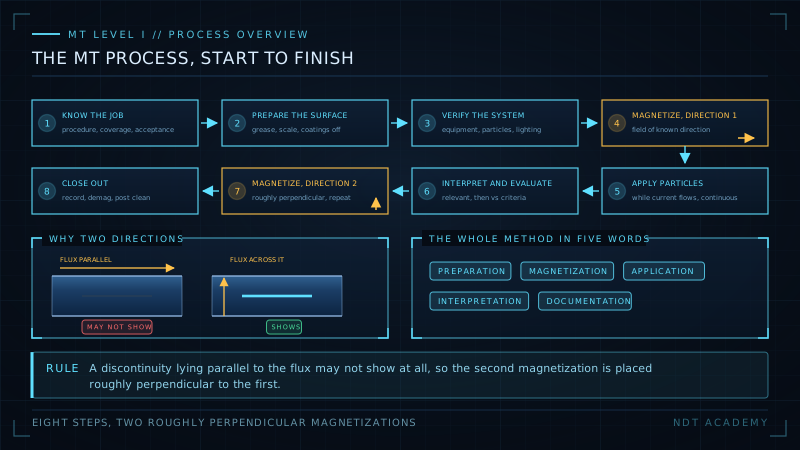
For MT, study how the examination creates and verifies the required field instead of treating the presence of particles as evidence of a valid test. The published MT course covers field direction, equipment and process verification, interpretation and documentation.
Sources: ASNT's penetrant-process explanation.
Neither method answers every inspection question
PT cannot reveal a discontinuity that has no opening to the test surface. MT's near-surface capability is limited; it should not be treated as a general method for examining a component's full thickness. Those limits matter when the question concerns an internal condition rather than a surface indication.
Ask what the requested examination is intended to establish and what evidence it can actually provide. Finding an indication and deciding whether it meets acceptance criteria are separate questions to address in training and the applicable inspection procedure.
Sources: ASNT liquid penetrant testing overview; ASNT magnetic particle testing overview.
Choose training for the work you expect to perform
Compare the MT and PT syllabi with your intended role, then ask your employer or Responsible Level III which method and level fit the qualification plan. Try the MT process and magnetic-field sample alongside the PT sample to experience the different teaching topics before enrolling.
For the wider qualification questions, use our guides to Level I and Level II training and training versus certification. Course completion documents training; the applicable employer or certification-body process determines the remaining requirements.
Sources and further reading
- ASNT magnetic particle testing overview
- ASNT liquid penetrant testing overview
- ASNT's penetrant-process explanation
Sources checked on September 6, 2026. Follow the current requirements from your employer or certification body when planning qualification or an examination.